Before and after
One Talend job from the public Packt project used in Get started, and the Hop pipeline the importer made from it, without any edit. The job reads a list of countries and their currencies, and writes the countries that use the euro to one file and the rest to another.
The Talend job

Drawn from Filtering3_0.1.item, the file the importer reads: the components, their positions
and their links are exactly what the export holds. It is not a screenshot of Talend Studio.
The Hop pipeline
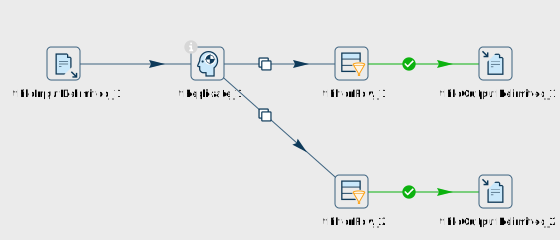
Drawn by Apache Hop from the generated Filtering3_0_1.hpl: this is what you see when you open it
in Hop GUI.
Component by component
| Talend | Hop | What carried across |
|---|---|---|
tFileInputDelimited_1 | Text file input | File name, ; separator, the two columns country and currency and their types (as a static schema definition in metadata/) |
tReplicate_1 | Dummy, copying rows | Every row goes to both outputs: the copy icon on the two hops |
tFilterRow_1 | Filter rows | currency == "EUR" becomes currency = EUR; matching rows go to the output on the true hop |
tFilterRow_2 | Filter rows | currency != "EUR" becomes currency <> EUR |
tFileOutputDelimited_1, _2 | Text file output | File name and extension, separator, no header |
Every component is reported AUTO, nothing is flagged, and the names are kept, so the report,
the pipeline and the original job all talk about tFilterRow_1.
Does it do the same thing?
We ran the generated pipeline on Hop 2.19 with the project's currencies.csv, changing only the
file paths (the job reads from C:/Talend/…). It writes 16 rows to eur-currencies.csv, all
EUR, and the other 10 to not-eurcurrencies.csv: what the Talend job writes. On your own jobs,
check this with a parallel run.
What this example does not show
This is one of the simplest jobs in the project, picked because it converts completely. The
report for the whole project shows what does not: every tMap
is flagged for its expressions, tFileList loops need rebuilding, and one tDenormalize has no
equivalent. That is where the work in a Talend migration is, and the report lists every case.